In April 2026, the median home sale price in DUMBO hit $2.4 million, a 90.9% jump from the year before. Look at Redfin's numbers from three months earlier and DUMBO's median was $2.6 million, up 19.2% year over year, but homes were taking 220 days to sell compared to 71 days the previous January. Two data sets, two different growth stories, and neither one tells you what you actually need to know if you are comparing DUMBO to another Brooklyn or Manhattan neighborhood before making an offer.
The reason isn't sloppy math. It's sample size. DUMBO closed just 6 sales in April 2026 and 11 in January. When a neighborhood's entire monthly transaction count would fit in a single elevator, one $16 million penthouse or one distressed estate sale can swing the median by six figures and the price-per-square-foot by hundreds of dollars. The headline number isn't wrong. It's just not measuring what you think it's measuring.
What it's actually revealing, once you look past the noise, is that DUMBO has two housing markets operating under one zip code, and they behave nothing alike.
The Number That Doesn't Mean What It Looks Like
Put the two data points side by side and the contradiction becomes the story. PropertyShark's April 2026 figures show DUMBO's median price per square foot at $1,631, up 6.1% year over year. Redfin's January 2026 figures put the median price per square foot at roughly $1,250, down 28.9% year over year. Both are describing the same three-month window in the same neighborhood, and they disagree on the direction of the trend.
That kind of disagreement doesn't happen in a market with hundreds of monthly closings. It happens when a handful of high-floor sponsor sales in one month and a cluster of resale lofts in another can each dominate the average. If you're pricing a purchase off a single quoted median, you're essentially trusting a coin flip about which few transactions happened to close.
The fix isn't to find a better median. It's to stop treating DUMBO as one market and start asking which of its two markets a specific listing belongs to.
Two Buildings, One Neighborhood, Two Different Economics
DUMBO's housing stock splits cleanly along a line drawn in 2007, when the Landmarks Preservation Commission designated the neighborhood as the city's 90th historic district, protecting roughly 91 buildings built almost entirely between 1880 and 1930. Everything inside that boundary falls into one of two categories: a landmarked industrial building converted to residential use, or new construction built after the district's boundaries were set.
The Clocktower Building at 1 Main Street is the clearest example of the first category. Built in 1914 for paper-box magnate Robert Gair as the tallest reinforced concrete building in the world at the time, it was converted into more than 120 condominium units in 1998 by developer Two Trees Management. The building's ground floor still opens onto Bubby's restaurant, and its distinctive four-sided clock tower remains one of the most photographed features on the Brooklyn waterfront.
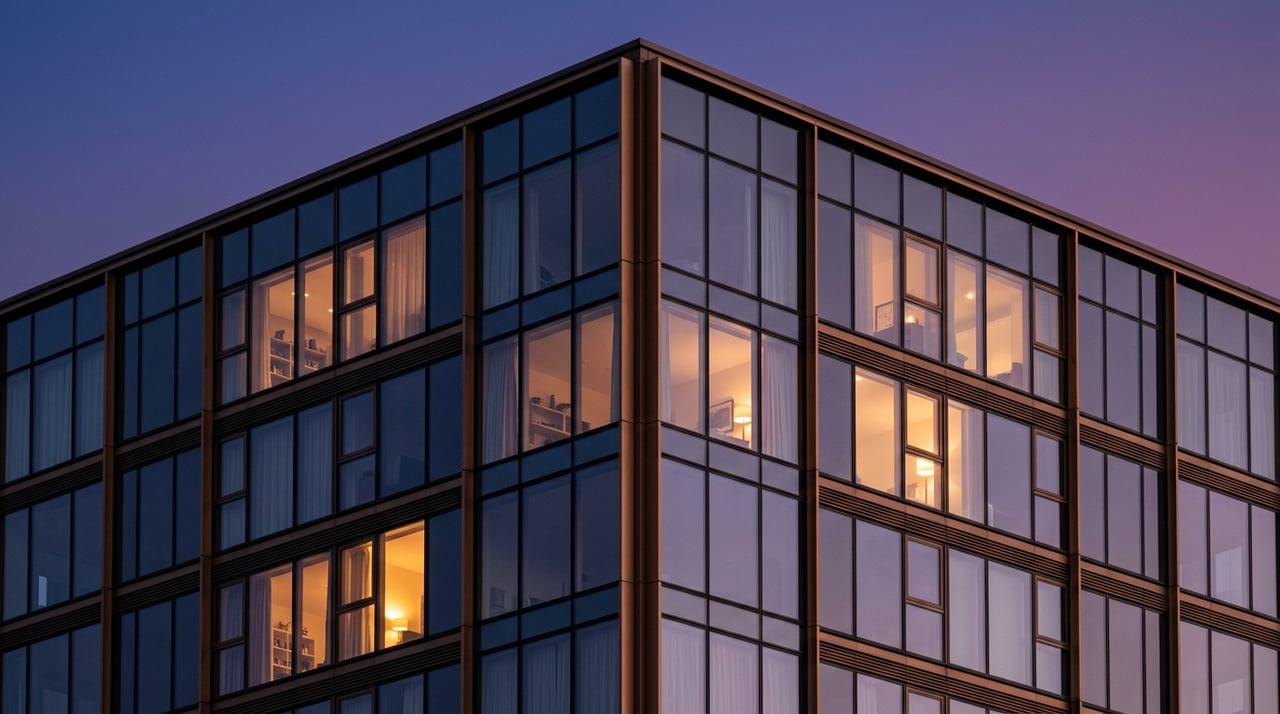
Olympia, the sponsor tower at 30 Front Street from Fortis Property Group, represents the opposite end of the spectrum. In February 2026, Penthouse B at Olympia closed for $16.25 million, or $3,297 per square foot, setting a new record for a Brooklyn sponsor condo sale. The unit had already picked up a second identity as Denzel Washington's fictional apartment in Spike Lee's 2025 film "Highest 2 Lowest."
| Landmarked Conversion (example: Clocktower Building) | New Construction (example: Olympia, 30 Front St) | |
|---|---|---|
| Structure | 1914 reinforced concrete, converted 1998 | Ground-up construction, delivered post-designation |
| Exterior changes | Require Landmarks Preservation Commission review | No LPC review required |
| Recent pricing signal | Recent Clocktower Building sales have averaged around $1,450 per square foot, with current listings asking closer to $1,476 | $3,297 per square foot on a February 2026 penthouse sale |
| What you're buying | Historic mass, character, fixed floor plates | Modern systems, sponsor financing terms, unrestricted renovation |
That gap, roughly $1,450 a foot in a century-old conversion against $3,297 a foot in a new sponsor tower, is doing most of the work in DUMBO's volatile monthly median. When a multimillion-dollar sponsor closing lands in the same month as a handful of loft resales, the blended number tells you almost nothing about what a typical purchase actually costs.
What Landmark Status Actually Costs You
Buying into the historic district side of DUMBO means buying into a design review process that doesn't exist in the new towers. Any exterior change, from window replacement to a rear addition, needs Landmarks Preservation Commission approval, and that process has a track record of taking months and multiple hearings even for well-designed, ultimately-approved projects.
The clearest local example is Alloy Development's proposal for five townhouses at 55 Pearl Street. The commission first considered the design in February 2013, sent it back for revisions after preservation groups objected to its bulk, and didn't grant final approval until a second hearing on March 12, 2013. The final vote was unanimous and commissioners praised the finished design, with one noting how its concrete grid echoed the district's historic window patterns, but the project needed two public hearings and a redesign to get there.
51 Jay Street tells a similar story from the inside of a warehouse rather than a vacant lot. Once a machine shop for the E.W. Bliss Company, a firm that made industrial machinery in the district, the building's condo conversion was still described in 2016 as a "historically sensitive condo-conversion process" even after scaffolding had come down and the work was nearing completion. That's not a criticism of the outcome. It's a preview of the timeline anyone should expect when a renovation plan involves a landmarked facade.
None of this applies to a unit at Olympia or another post-designation tower. New construction sits outside the historic district's review process entirely, which is part of why sponsor pricing there can move so fast in the opposite direction from resale pricing in the conversions.
"DUMBO's distinctively designed buildings and sublime vistas survive to this day," Landmarks Preservation Commission chairman Robert B. Tierney said when the district was designated in December 2007.
That sentence is also a fair description of what a buyer signs up for when they choose a converted loft over a new tower: the vistas and the design character stay fixed in place, and so does the approval process required to change them.
The Concrete Nobody Mentions on a Walkthrough
There's a structural detail specific to DUMBO that rarely comes up until an inspection is underway. The district contains some of the earliest large-scale reinforced concrete factory buildings built in the United States, a construction method that was still new when Robert Gair, the Arbuckle Brothers, and other manufacturers put up their warehouses between 1880 and 1930.
Reinforced concrete ages differently than the wood-frame or masonry construction more common in brownstone Brooklyn. It doesn't have the rot or termite risk of a wood structure, but a century-old concrete building can develop rebar corrosion and spalling in ways a general home inspector may not be trained to flag. If you're weighing a unit in one of DUMBO's converted warehouses, a structural engineer familiar with early reinforced concrete is a more useful line item than a standard inspection alone, particularly for below-grade or exterior-facing units where water intrusion has had a century to find its way in.
What This Means If You're Comparing Neighborhoods
If DUMBO is on your shortlist against another Brooklyn or Manhattan neighborhood, the headline median is the wrong tool for that comparison. Before you price a specific unit against the neighborhood average, ask:
- Is this building inside the 2007 historic district boundary, or was it built after designation?
- If it's a conversion, what year did the building convert, and is there a documented Certificate of Appropriateness on file for any exterior work already completed?
- If it's new construction, is the price reflecting a sponsor unit still in its first sale, which tends to set the high end of the range?
- How many comparable units in that specific building, not the neighborhood, have closed in the last six months?
That last question matters more in DUMBO than almost anywhere else in Brooklyn. With monthly closings still in the single digits some months, per-building comparables tell you far more than a borough-wide or neighborhood-wide median ever will.
Frequently Asked Questions
Do I need Landmarks Preservation Commission approval to renovate a unit inside a converted DUMBO warehouse? Interior renovations generally don't require LPC review, but any change visible from the street, including windows, is subject to approval. Projects like 55 Pearl Street show that even well-designed proposals can take multiple hearings to get approved.
Are DUMBO's warehouse conversions co-ops or condos? The best-known conversions, including the Clocktower Building, converted as condominiums rather than co-ops, which is typical for large-scale industrial-to-residential conversions in this era of New York development.
Why do DUMBO's price-per-square-foot numbers vary so much between data providers? With transaction counts in the single digits some months, a small number of very high-priced or very typical sales can swing the monthly figure sharply in either direction depending on which sales closed in that specific window.
If you're weighing DUMBO against another neighborhood and want to know which of its two markets a specific listing actually belongs to, Lena Simpson can walk through the building-level history, the landmark status, and the comparable sales that the headline numbers leave out. Request a Personalized Consultation to get a read on the market that goes beyond the median.