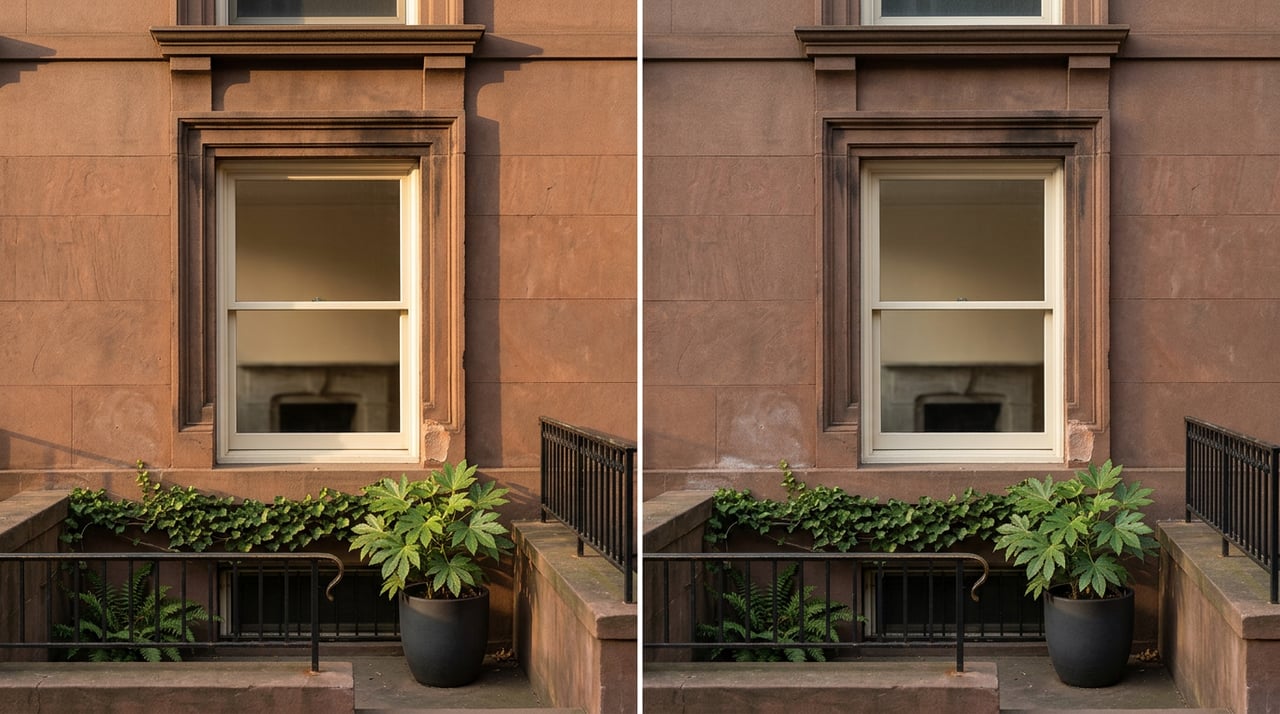
Two numbers came out of Brooklyn Heights this year that cannot both be true. In March 2026, Redfin logged a median home sale price of $2.7 million for the neighborhood, up 91.8 percent from the year before. By the second quarter of 2026, PropertyShark put the median at $870,000, down 27 percent year over year. Same dozen blocks. Same twelve months. Opposite stories.
Neither number is wrong. Both are close to useless for pricing an actual house, and the reason why explains more about how this market works than either headline does on its own.
A Market Too Thin to Average
Redfin's own count tells you why the swings are so violent: 39 homes sold in Brooklyn Heights in March 2026, down from 45 the year before. That is not enough volume to produce a stable median. It is a sample small enough that a single trophy closing, or the absence of one, can move the number by ninety points in either direction. One analysis of Brooklyn's luxury submarkets flagged this pattern directly, warning against reading a 92 percent jump as the real market when it is almost certainly the result of a handful of high-value closings rather than a genuine shift in value. Price per square foot in the neighborhood sat closer to $1,510 over the same period, moving somewhat independently of the median, a pattern researchers describe as a mix shift: fewer trophy units trading, more mid-size product filling the gap.
Financing adds another layer to the picture. The 30-year fixed mortgage rate sat at 6.49 percent as of June 25, 2026, according to Freddie Mac, a level that keeps rate-sensitive segments of the Brooklyn market slower to turn over while supply-constrained brownstone blocks like the Heights tend to hold their pricing regardless.
If you are pricing a listing off "the Brooklyn Heights median," you are pricing off noise. If you are pricing off the sale that just redefined the top of this market, the picture gets a lot clearer.
The Sale That Set the Ceiling
In July 2026, a landmarked five-story brownstone at 192 Columbia Heights sold off-market for $24.5 million, according to public records reported by The Real Deal, Brooklyn Eagle, and Hoodline. It is Brooklyn's priciest residential closing of the year. The Civil War-era house runs roughly 25 feet wide and spans about 7,900 square feet, with seven bedrooms and three bathrooms.
The buyer is an anonymous LLC called Luffy & Friends, using the Manhattan address of the law firm Sullivan & Cromwell. The deed on the seller's side was signed by Andrew Fishkoff, chief operating officer and general counsel of Eastbridge Group, who previously held counsel roles at Macklowe Properties and Rockrose Development. Serhant's Ravi Kantha represented the seller. Kantha, discussing the broader Heights market separately, put it this way:
"a direct competitor to the Village and Upper East Side for some of New York City's wealthiest people."
The house carries its own pricing history worth knowing for anyone building comps. Its previous owners bought it in 1996, listed it in 2014 for $16 million hoping to set a record of their own, and ultimately sold four years later for just under $12 million. This year's price more than doubled that 2018 number. That kind of swing on one address, in under a decade, is the median-price problem in miniature. It is also why the trophy tier still sitting above it, 8 Montague Terrace at $25.5 million in December 2020 and 1 Sidney Place at roughly $22.1 million in 2025, matters far more to a seller's pricing conversation than any borough-wide average.
What Is Actually Trading Beneath the Ceiling
Below the trophy tier, recent listings show where the real comp set lives:
- 75 Columbia Heights, an Italianate brownstone with waterfront views and central air, asking $12.75 million
- 145 Clinton Street, a renovated circa-1850s row house that kept its marble mantels and original stair, asking $5.7 million
- 28 College Place, a carriage house on a quiet mews, asking $5.795 million
- 25 Cranberry Street, a wood-frame house with wide-plank floors and Federal-era mantels, asking $4.9 million
Even an institution is testing this band. The Brooklyn Bar Association, headquartered in a Brooklyn Heights brownstone since shortly after its founding in 1872, listed its landmarked home at 123 Remsen Street for $12 million this year. Known as the Charles Condon House, the French Second Empire building is being pitched as a conversion or owner-user opportunity, with the association stating the sale would not disrupt its ongoing programming.
None of these numbers come from a median. They come from width, condition, proximity to the Promenade, and one factor the portals do not track well at all: what has already been approved.
The Paperwork That Actually Moves the Needle
Brooklyn Heights became New York City's first historic district in 1965, and today the neighborhood is effectively landmarked in its entirety, with more than 600 pre-Civil War homes still standing inside its boundaries. That means almost any exterior change, a window, a stoop rail, a rooftop bulkhead, needs sign-off from the Landmarks Preservation Commission before the Department of Buildings will accept a permit application. The sequence runs one direction only: LPC first, DOB second.
The Commission sorts that review into tiers. Straightforward, restorative work such as in-kind window replacement can move through a staff-level Permit for Minor Work, often approved within about ten business days and legally decided within twenty once the application is complete. Anything larger, a rooftop addition, a facade change, a new rear extension, requires a full Certificate of Appropriateness, which means a public hearing and adds at least ninety days to the calendar.
That calendar is not always available. Community boards, which review Certificate of Appropriateness applications before they reach the LPC's own hearing, go on recess through July and August and do not take up private residential applications during those months. A seller assembling documentation right now, in early August, is working against that recess. Anything still needing a hearing will not move again until the boards reconvene in September.
Public hearing notices from earlier this year show how often this plays out on these exact blocks. The Commission took up applications for a Federal-style rowhouse on Cranberry Street seeking to install windows in blind openings, a Neo-Renaissance rowhouse on Pierrepont Street designed by J.C. Cady seeking an areaway lift and rooftop bulkhead, and a Greek Revival commercial building on Atlantic Avenue seeking a rooftop addition. Each of those filings becomes a piece of paper a future buyer's attorney will ask to see.
That is the actual friction point in a Brooklyn Heights sale. A buyer's attorney and appraiser do not underwrite the median. They underwrite the file: is there a Certificate of No Effect or Certificate of Appropriateness on record for the windows, the stoop, the roofline. Work done without one can trigger fines, a stop-work order, and a requirement to restore the original condition, any of which can freeze a closing at the worst possible moment.
Before You List
- Pull the building's landmark designation report and confirm which features are protected.
- Gather every Certificate of No Effect, Permit for Minor Work, or Certificate of Appropriateness on file for prior exterior work, including windows, doors, stoops, and roofline changes.
- Confirm, in writing, that any visible work was closed out with the Department of Buildings, not just approved by the LPC.
- If anything still needs a hearing, plan around the community board recess. A filing submitted in August will not reach committee until September at the earliest.
- Price against comparable landmarked sales on comparable blocks, not against a borough-wide median that a single closing can move by ninety points.
Frequently Asked Questions
Does every exterior change on a Brooklyn Heights brownstone require a public hearing? No. Straightforward, in-kind work, such as replacing a window with a matching profile, typically qualifies for the staff-level Permit for Minor Work track, which the Commission is required to decide within twenty business days of a complete application.
What happens if I sell with landmark work that was never approved? The exposure passes to the new owner. Unpermitted exterior changes can draw fines, a stop-work order, and a requirement to restore the original condition, any of which a title search or attorney review can surface late in a transaction.
Why did 192 Columbia Heights sell for less in 2018 than its 2014 asking price? Public records show the sellers listed the house for $16 million in 2014 hoping to set a record, then sold four years later for just under $12 million. Even a trophy Brooklyn Heights address can sit on the market for years before finding a buyer willing to pay a given number, regardless of what a median suggests that year.
Selling a landmarked brownstone in Brooklyn Heights takes more than a comp sheet. It takes a clean file. Lena Simpson has spent more than twenty years working New York City's most document-heavy transactions and can tell you, block by block, what a buyer's attorney will ask for before they ask for it. Request a Personalized Consultation to start pricing your Brooklyn Heights property against the paperwork that actually matters.